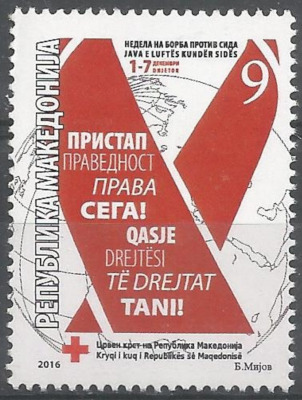
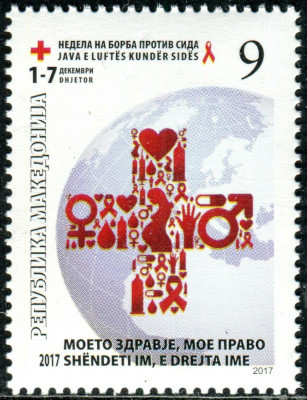
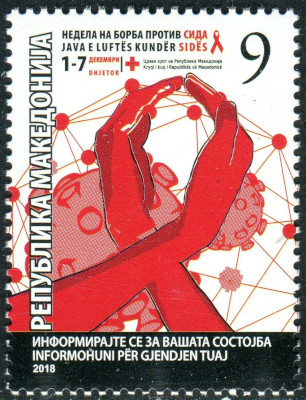
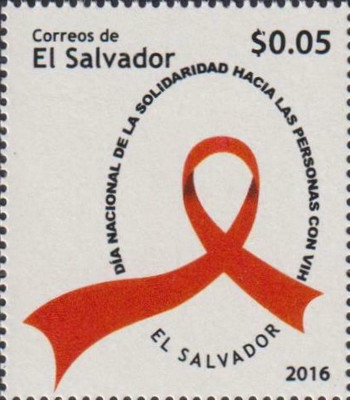
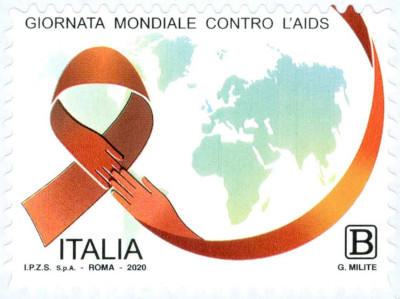
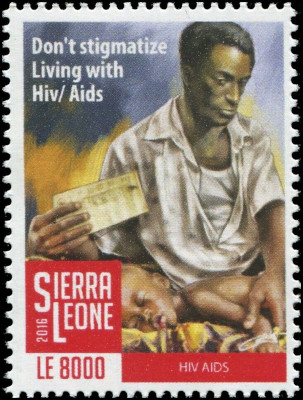
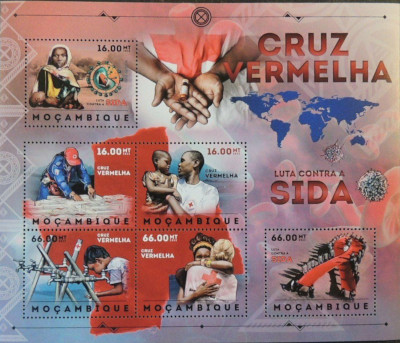
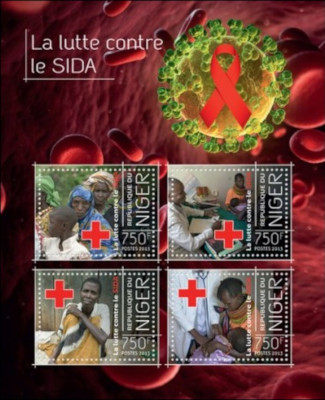
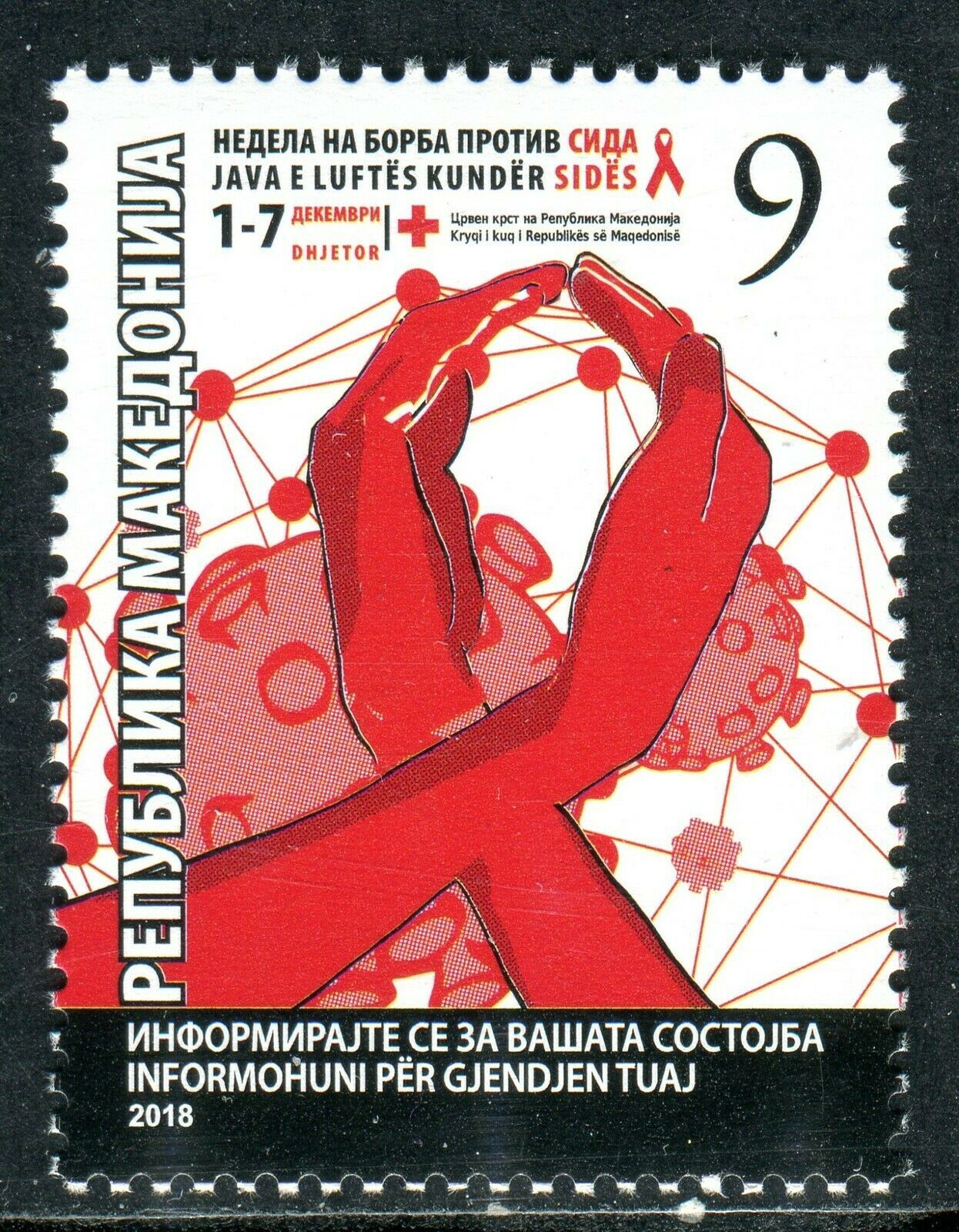
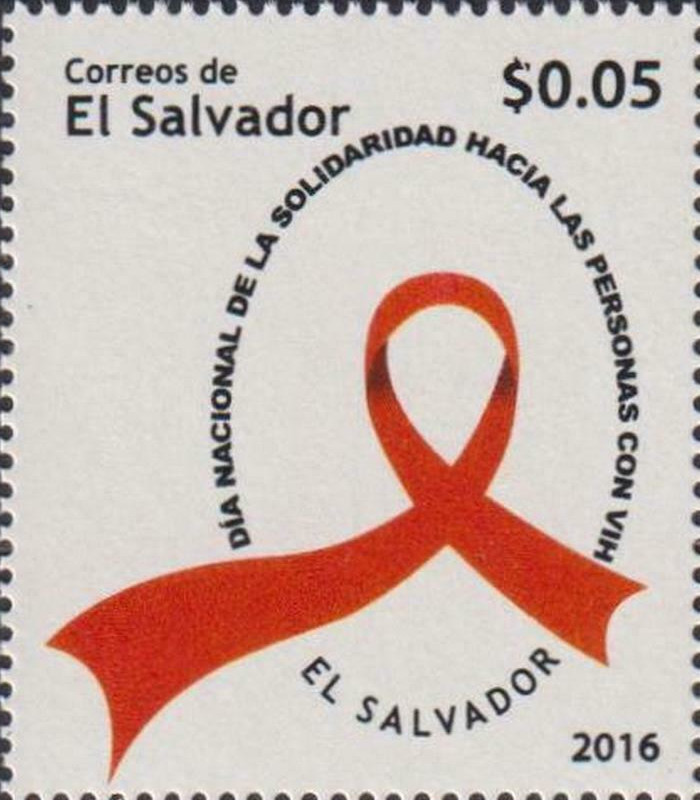
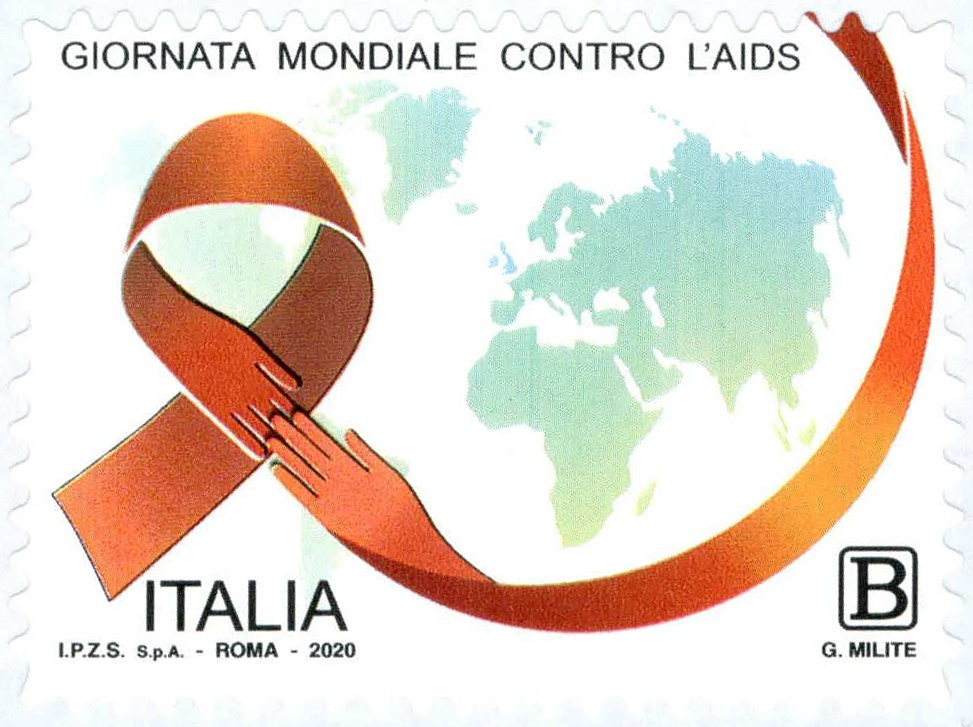
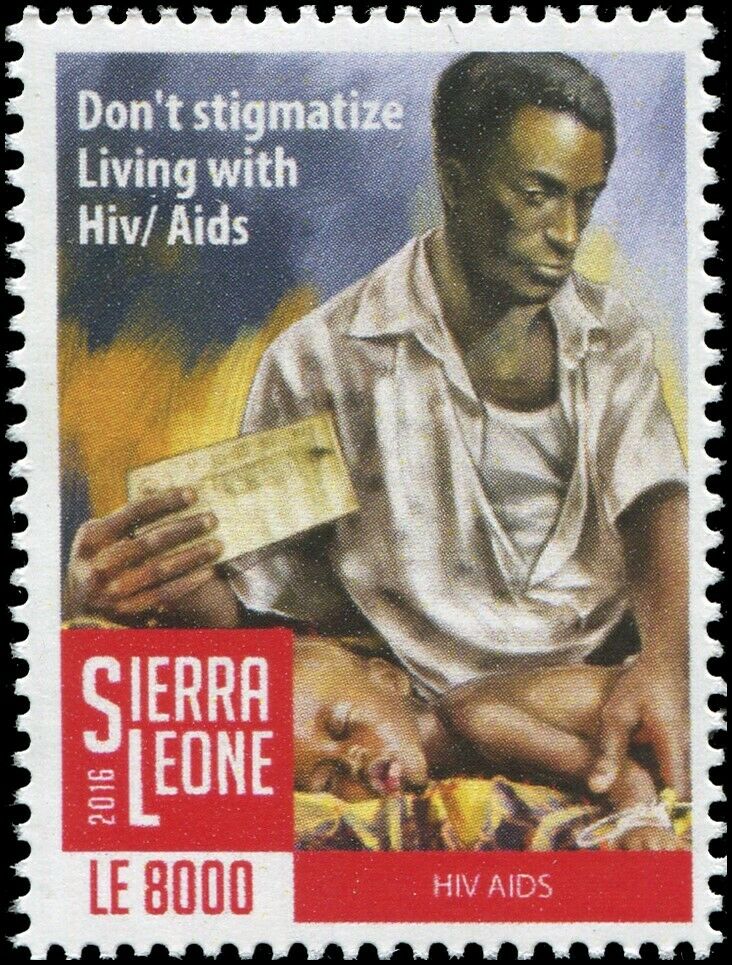
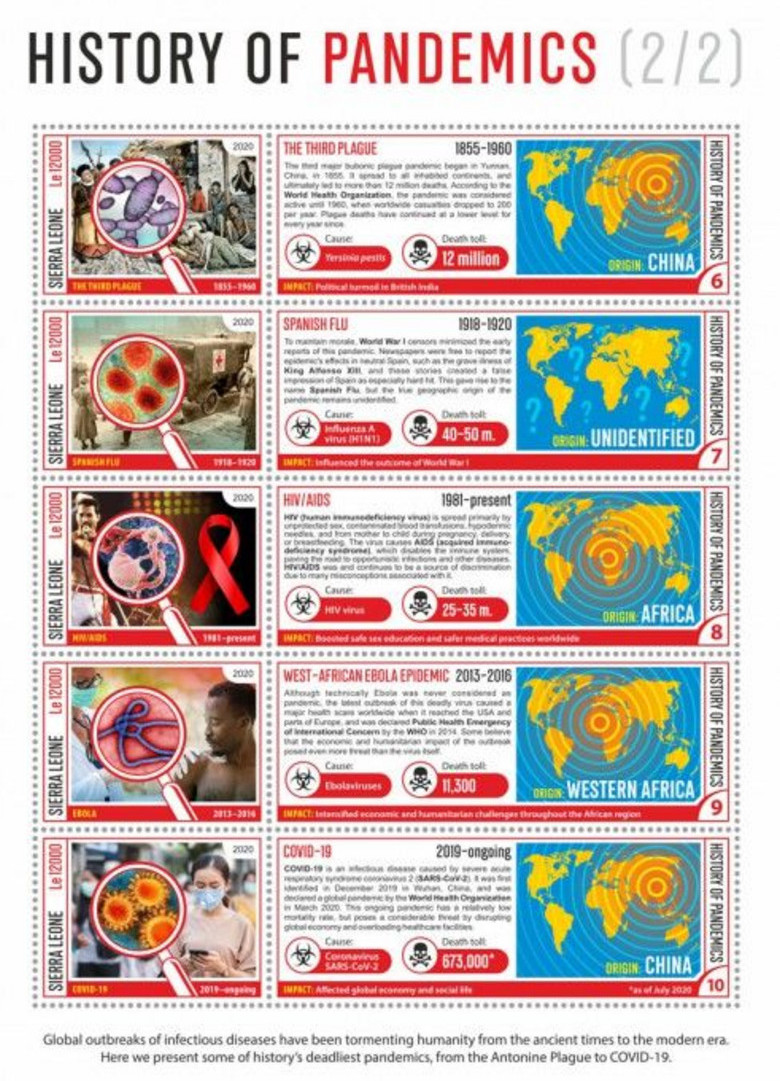
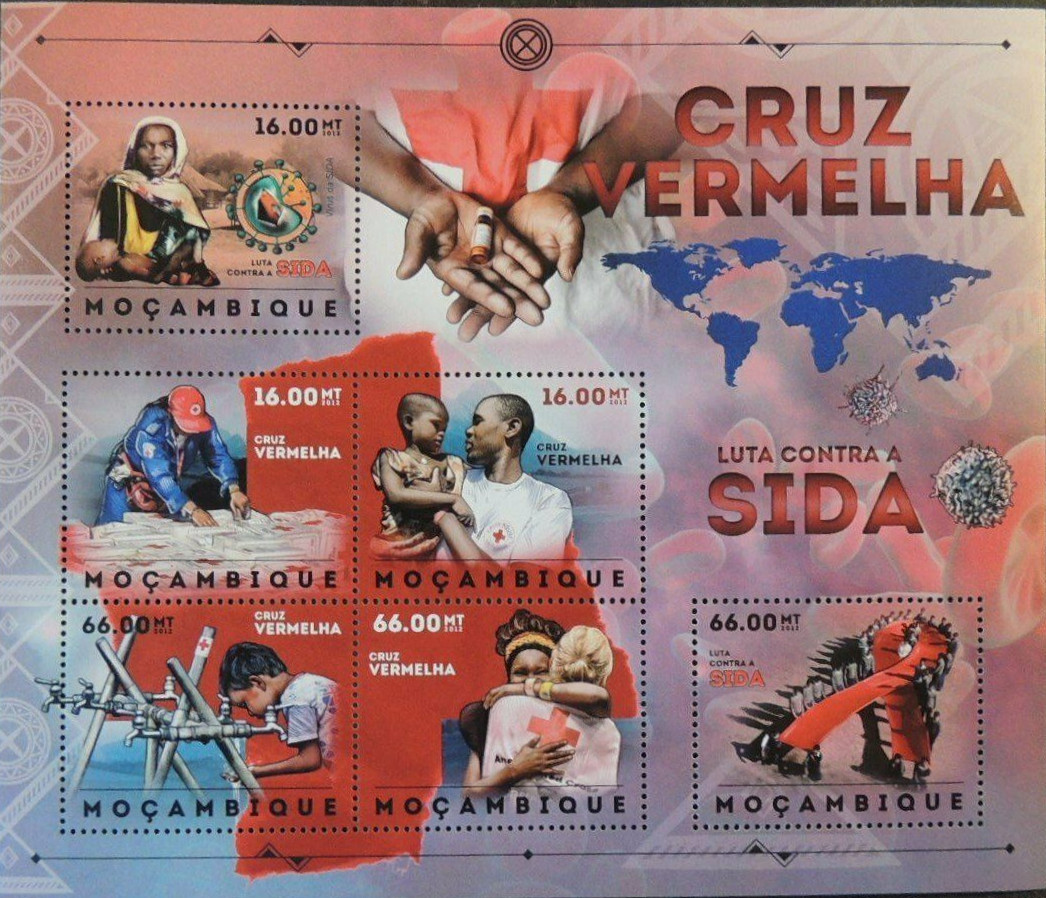
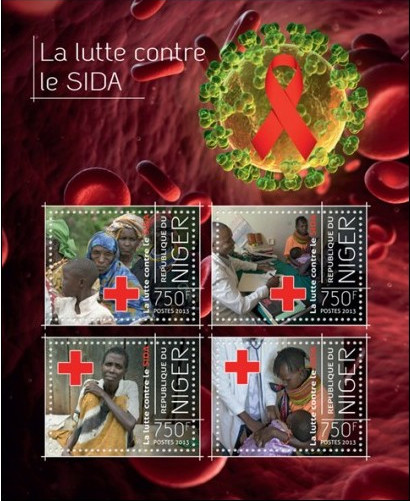
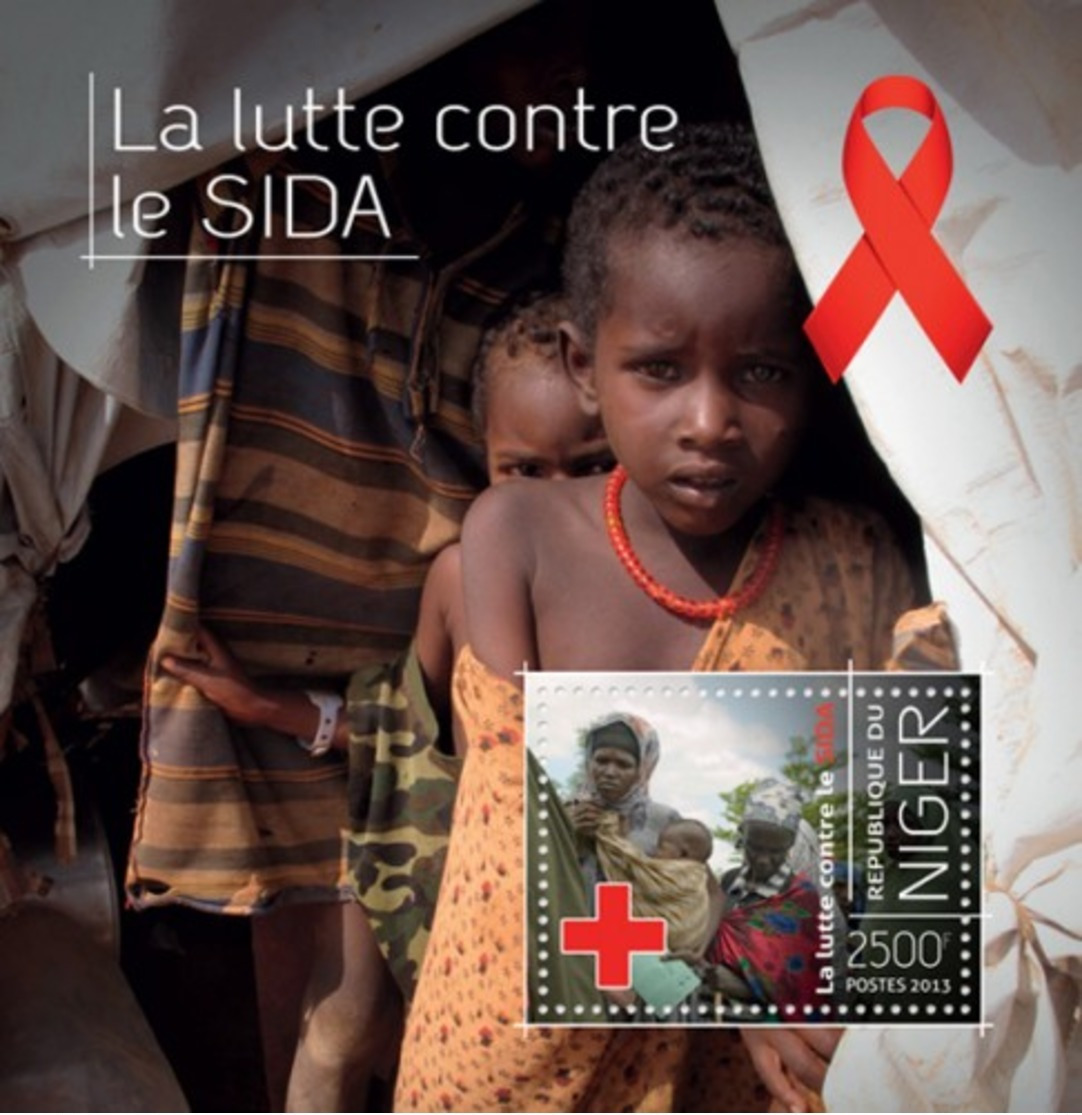
AIDS on Stamps showcases how the AIDS epidemic has been seen on stamps from around the world.
News
- January 31, 2012
- No new stamps today, but there's a bit of news to report.
Jurgen in Germany was kind enough to do some research on the 1991 Etiopian stamp that we are investigating. As you may recall, it was once on the AIDS on Stamps Project Newsletter list of AIDS stamps, but then was removed without explanation. A scan of this stamp revealed what might be an AIDS stamp, but it wasn't clear.
Well, Jurgen was kind enough to e-mail me a higher resolution scan of this stamp. From the image it was clear that the red wasn't a ribbon, but was an X.
Jurgen also inclided some text from the official flyer of the stamp issue. According to Jurgen...
"The set has been dedicated to the official opening of the WHO Centre for Emergency Preparedness and Response for Africa (EPR( in Addis Ababa on March 6, 1991, under the theme: International Decade For Natural Disaster Reduction (1990 - 2000). This socalled Panafrican centre was supposed to give service for African people living in disaster - prone areas and to assist the counries in Africa to cope with catastrophes such as drought, flood, cyclone, earthquakes, civil wars (interesting to note that wars were recognized as natural disasters) and mass population movements. The flyer furthermore explains in muchdetails the functions and activities of the EPR program. There is nothing mentioned specifically on AIDS.
"Since the Ethiopian AIDS stamp set was issued on January 31, 1991, ie just a few months before, it seems very unlikely that another AIDS related stamp would be part of the April stamp edition. In my view, the Scott 1314 stamp shows a scene with mothers and their little ones participating in a vacination program. At that time, as is true today, no vaccination was available against the AIDS virus."
So there you have it. Jurgen and I are in agreement. The stamp isn't about AIDS. Accordingly, I have placed it on the Not About AIDS page.
Second, Jurgen was kind enough to send me a .pdf file for the missing AIDS on Stamps Project newsletter. We now have a complete set of their newsletters. Althoug the Project itself closed years ago, I can't help but to think Blair would be highly pleased knowing his newsletters were still out there for research purposes.
More news coming soon. I'm finally sorting through my mailbag, but I'm out of time for now. - January 30, 2012
- New stamps and other news today.
First, a Morocco stamp from 2011. This is part of their effort to publicize the UN Millenium Development Goals. On the bottom you'll see a little pill bottle. This is the UN's logo for the "Fight HIV/AIDS, Malaria, and Other Disesases" goal.
Second, a 2008 stamp of Princess Diana from Guinea Bissau. On her outfit she is wearing a red AIDS ribbon. This is part of a six stamp sheet titled, "Defenders of Peace" featuring the likes of Pope John Paul II, Gahndi, Mother Teresa, Princess Diana, Jimmy Carter, and Martin Luther King, Jr. It's a rather shameless ploy to attract international collectors for a stamp sheet undoubtedly not sold at home. Is it valid though? Michel and Yvert seen to think so, with numbers 3954 and 2677 respectively. That doesn't mean it's not a case of excess stampage though, something for which Guinea Bissau is infamous.
Third, Ricard was kind enough to supply a whole mess of images of pre-stamped envelopes. I have added them to the envelopes page.
These envelopes from Bulgaria were released in 1998 and 1999 respectively.
These two are from Russia in 1989 and 1990.
These are the front and back images of an 2001 Australian pre-stamped envelope.
And this final one is from Romania in 2006.
More news in the next few days. - January 24, 2012
- Welcome to 2012! As you might expect from a 40+ day break, there are new stamps to report.
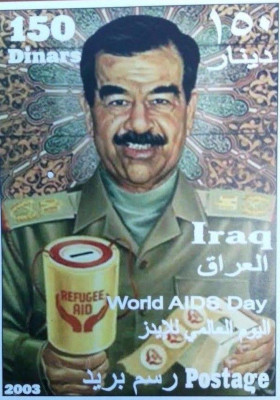
First up, we have a new 2011 stamp from Iraq.
Second, a new 2011 stamp from Paraguay. The stamp is on the left. I believe the right to be some sort of tab.
Third, Ricard found this pair of imperforated versions of Mali's 1994 stamps. These are not new stamps, but they are versions not previously cataloged on this website.
Fourth, a new 2011 stamp from Uzbekistan. This one does not appear to be making significant rounds, so it may be tricky to pick up. If you see it, you may want to buy it fast.
Fifth, an interesting discovery from Jurgen in Germany. As you may remember, Yemen has a 2005 set of stamps about the United Nations Millenium Goals for Development. One of these is an AIDS stamp. What I never noticed is that a second stamp in the set, Scott 828, features a UN-ish logo with smaller icons from all of the other stamps. Part of that logo has a small AIDS ribbon in it. Look carefully and you'll see it.
Lots of other news to report, but these are the new stamps. Keep an eye on the site over the next few days. - December 13, 2011
- The promised mailbag delivery will have to wait, as there are new stamps to report.
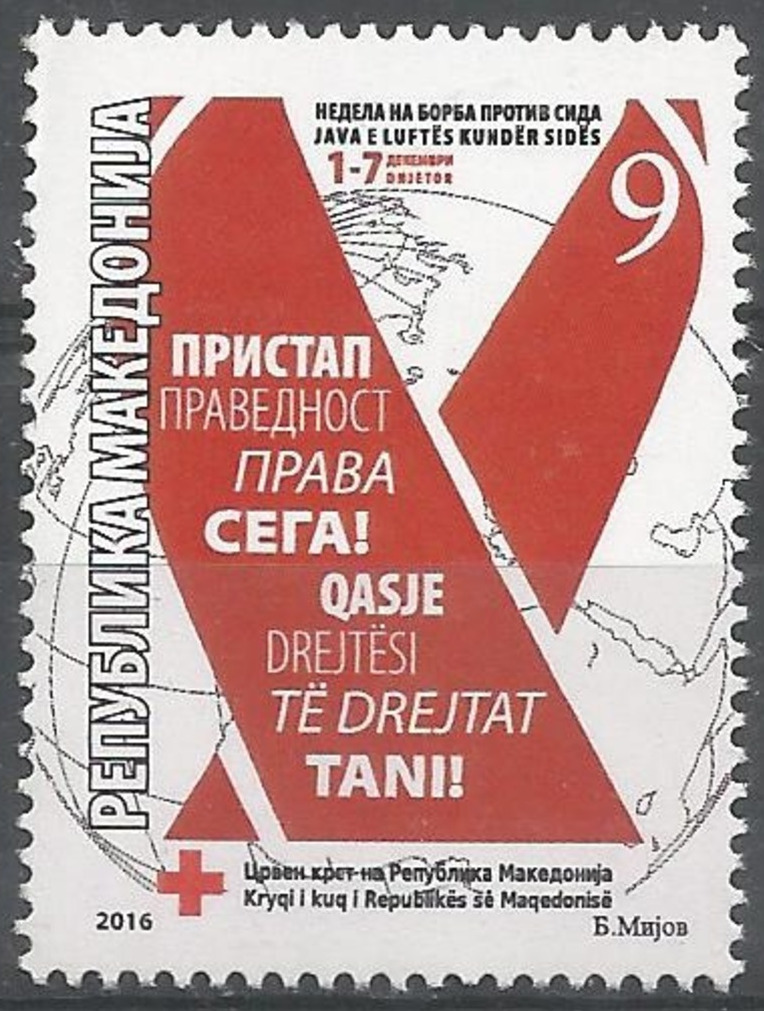
First, this year's Macedonian tax stamp has been unveiled. Sorry for the blurry scan, but it's all I have so far.
Then there is this release from Cameroon. Like all of their stamps designed for domestic use, this one is likely going to be difficult to collect. If you see it available for sale, I suggest picking it up immediately. According to the date on the stamp, it was released on June 3. So the fact we haven't heard about it until now suggests that it's going to be quite rare indeed.
Of note is that the woman on the stamp is the country's first lady. She's is one of the chief promoters of the Chantal Biya foundation that was released on their 2001 stamps.
Finally, a pre-printed envelope from Russia. They cheaped out on releasing an AIDS stamp, but did make this contribution to the UPU's commemoration this year.
Now that we know what Russia did this year, we can cross it off our list of philatelic releases to identify. - December 8, 2011
- I am pleased to finally offer Xtophe's presentation on AIDS stamps.
It is on display in Paris at 41 Rue des Blancs Manteaux on Wednesday, Friday, Saturday, and Sunday during December and January.
Or, for those of you who are not in Paris, you can see it on display here in .pdf format. The accompanying text is in French, but much is understandable by those of us who can only read English.
The presentation is divided into two halves. By topic, and by geography.
1988 (page 1, 2)
AIDS (1, 2)
Children (1, 2)
Condoms (1, 2)
The HIV Virus (1, 2)
Miscellaneous (1, 2)
Red Ribbons (1, 2)
Africa (1, 2, 3, 4)
Americas (1, 2)
Asia (1, 2)
Carribean (1, 2)
Europe (1, 2, 3, 4)
France (1, 2)
Macedonia (1, 2)
Oceania, India, and the Orient (1, 2)
Also, I want to give my apologies to Xtophe for spending the past week saying I needed to display Ricard's presentation. Ricard and Xtophe are two long-time readers of this website. Both started doing research for this website at approximately the same time. Both write me regularly and sometimes I get their names mixed up. Sorry about the confusion, and your presentation looks great, Xtophe.
Next update: More pictures of those odd French stamps. Plus stuff from my mailbag. - December 6, 2011
- Once again Ricard's presentation is delayed to bring you new stamps released on World AIDS Day.
First, we have this release from Sri Lanka.
The other is this release from Colombia.
- December 1, 2011
- Ricard's great presentation will have to wait a day because today is World AIDS Day, always a big day for new AIDS stamps. As of this writing (noon in eastern United States) we have two new stamps to present.
First, we have this simple stamp from Ukraine. It is available on a sheet of 12 with a small amount of AIDS text around the margin. Unless you are one that has to have everything AIDS-related interest in your collection, you will probably be happy with just the single stamp.
I haven't seen the sheet for this simple but elegant Armenian stamp, but here's an image of the single stamp.
Next update: Ricard's presentation or more stamps. Wait and find out! - November 30, 2011
- Brazil is finally releasing their long-awaited stamp sheet on December 1, and the image sure are cute.
As their contribution to the UPU's 30th Anniversary of the Discovery of the AIDS Virus effort, Brazil has released a sheetlet with eight different AIDS stamps. All eight were drawn by Brazilian cartoonist Ziraldo.
I am seeing this image in both horizontal and vertical versions, so I am not sure how the sheetlet actually looks.
Next update: Ricard's AIDS stamp presentation. - November 29, 2011
- An issue of Universal Postale (.pdf file, available in English, French, Spanish, Arabic, Chinese, German, and Russian) has an article (on page 24) discussing the vast array of AIDS stamp releases this year. According to their list, there are releases from Belarus, Brazil, Burkina Faso, Cameroon, Bosnia and Herzegovina (Mostar), Fiji, Iran, Iraq, Kazahhstan, Luxembourg, New Caledonia, Malawi, Moldova, Pakistan, Slovakia, Romania, Russia, Serbia, Turkey, Ukraine, United Nations (all three offices), and Uruguay. Some of these countries have released stamps, other are releasing pre-stamped postcards or envelopes.
Of those countries, most of them have released their stamps already. Others we know are set to be released later this year, along with a few countries not listed in the article.
Armenia - One stamp and one souvenir sheet with two stamps, third quarter 2011.
Brazil - Set of eight stamps. Now released - more on this tomorrow!
Russia - A pre-stamped envelope, unknown date.
Ukraine - One stamp for World AIDS Day on December 1.
This leaves Cameroon, Iran, Iraq, New Caledonia, Malawi, Moldova, Slovakia, and Turkey.
We know New Caledonia released a pre-stamped envelope earlier this year. To give it a permanent home on the website, I have created a new pre-stamped envelope page. And to go along with that, a pre-stamped postcards page, although there is nothing on the postcard page at the moment. If you've got scans of other pre-stamped postcards and envelopes (but not First Day Covers, that's different), feel free to e-mail me information on them to add to the page. I'll be working on those in a week or so.
Moldova and Slovakia released AIDS stamps at the end of 2010, so that's probably how they got on the list.
This brings us down to just Cameroon, Iran, Iraq, Malawi, and Turkey. If you have any information on the releases from those countries, I'd love to hear it.
Tomorrow: A new set of stamps from Brazil - November 22, 2011
- I'm working my way through a pile of interesting news bits that have reached my e-mailbox. It's going to take me a week or so to get through it all. Here's one that arrived from Ricard.
Frank Jump is an artist who has released a book called Fading Ads of New York City. It's a collection of historical advertisements in New York City that have been photographed before they are lost to time. As part of the book, there are several AIDS awareness messages. Normally these would be out of the purview of this website, but several of these advertisements are designed to look like stamps. Accordingly, I thought they might be of some small interest to you.
Again, these are not available as cinderella stamps. But they were posters, signs, and such made between 2006 and mid-2007 (the years a stamp cost 39 cents).
Next update: What the Universal Postal Union is saying about their big AIDS education effort. - November 21, 2011
- It's been a couple of months since my last update, in part because the server on which I design this website was down for repairs. It's back up now, and so I am ready to present a new update for you. And what an update it is!
First, on September 1, 2011 the country of St. Lucia released this AIDS stamp.
Second, on August 8, 2011 Burkina Faso released these two stamps.
Third, Dominica has released this stamp. I believe it is the first time I have ever seen a phone number on a stamp.
Fourth, we have this colorful stamp from Mauritius.
Fifth, Ricard has been supplying me with lots of useful information such as the date on this pair of Peruvian stamps. Their official release date was June 13, 2011.
He also supplied this additional picture for a South African stamp booklet. We already have this booklet listed on the booklets page, but now we have a good photo of the inside.
Sixth, I stumbled across this personalized AIDS stamp from France.
Seventh, remember that odd French cinderella stamp I found a few months ago? Well, another similar image came up for sale recently. I snagged this image from it.
I'd still like to know the story behind that stamp, but in the meantime it's worth checking out these images.
There's lots more news to report, but I want to get this part updated.
Tomorrow: A history lesson from AIDS street activism in New York City. - September 23, 2011
- I found this interesting set of French stamps recently on eBay.
Little information was provided with them. It stated that "issue" location and date was France from 1991 to 1995. But it also stayed that it was a "unissued private project", meaning it is not valid postage. The stamps are also missing print that all stamps of that time period in France contained. This begs the interesting question -- what are these stamps all about? I have added this listing to our cinderella page, and will let you know if I ever hear anything more.
The only other news is that Brazil has confirmed it will release a set of eight(!) AIDS stamps in December. Along with this there will be one "edital", which translates as "announcement". I have no idea what the announcement refers to, but it's nice to know there'll be such a big stamp set coming. The philatelic program indicates that this is a confirmed release, but no date is specified. - September 17, 2011
- Earlier this summer Cambodia released four AIDS stamps as seen here:
What most people didn't know is that it was originally intended to be a five-stamp series. One of the stamps was removed from the project at the last minute over content and financial concerns. I suspect this is what led to the rumors about a souvenir sheet aso being made available.
According to the Cambodia Stamp Issues blog, the 5th stamp was to look like this:
The blog entry about the stamp is quite interesting and gives the background on the whole set, as well as images of what would have been the first day cover had the 5th Cambodian stamp been released. This makes me wonder if we'll someday see the proof of the missing stamp appear for sale.
Next update: An odd French cinderella stamp sheet. - September 16, 2011
- Xtophe spotted this oddity on the Austrian postal website a few days ago -- two AIDS non-stamps for sale.
Both harken back a few years to their earlier Life Ball stamps. For whatever reason, the Austrian postal service decided to release several not-valid-for-postage artstamps from 2005 and 2006.
First, the real stamps.
And now, the not-valid-for-postage versions.
I have no idea why Austria choose to release two stamps-that-are-not-stamps. But they did, and now you know they exist. Their postal website makes it clear though, these stamps are not valid for postage. Rather than calling them stamps, it calls them prints. But since no mention is made of them being a different size from the regular stamps, I assume they're the same.
Just for clarity and historical record, I have gone ahead and added these two non-stamps to the cinderella stamp page.
Coming next update: A Cambodian AIDS stamp that was aborted at the 11th hour. - September 13, 2011
- More on the Zaire overprint thanks to some fast research by Ricard. First, we've got a better picture of this stamp.
As you can see, the stamp was overprinted with a new domination of 10,000z, (up from 150z). And yes, that is 10,000 and not 10,000,000. According to Wikipedia's page on the Zairean zaire, the currenct was unusual in that it printed three zero's after the decimal instead of the normal two. Since the stamp features a new valuation, it is almost certainly done by the country's postal service.
The article indicates that the Zairean currency suffered from heavy inflation in the 1980's and early 1990's. In 1980 the largest currency banknote was 50z. In 1990 the largest note was 10,000z. And by 1992 there was a 5,000,000z note. As you'd expect, the country's economy was collapsing as people desperately tried to get rid of currency notes before they became worthless. Stamps, being a specialized form of currency, suffered the same problem. This explains why the overprint increased the value on the stamp from 150z to 10,000z when they were released just three years apart.
As you might expect from a government in crisis, it rapidly became cheaper to overprint stamps rather than release new ones. This page on CongoStamps.com. It's a list of overprinted stamps released in 1991 and 1992. Sure enough, the overprinted Zairean AIDS stamp is listed at the bottom of the page.
I wondered yesterday what the Scott Guide has to say about this release -- now we know. According to this page in the 2009 Scott Guide (.pdf file), many stamps were oveprinted during this time period but there is conflicting data as to the validity of the stamps. The Scott Guide asks anyone with more knowledge on the issue to contact them, meaning we'll probably never know for sure.
So it looks like we've got a new stamp on our hands. I'll add it to the 1992 page. Thanks to Xtophe for pointing out this stamp, and to Ricard for his excellent work in researching it. The only question I have left is whether the stamp was ever overprinted in its souvenir sheet form, or just on the stamp itself.
Coming next update: An interesting find from Austria. - September 13, 2011
- The news continues.
First, we have this new release from Luxembourg.
Second, the new Fiji stamps have at least one intersting tab attached to them as seen in this image.
Third, an interesting stamp variant that friends-of-the-website Xtophe and Ricard were able to identify. Xtophe initially asked about a variant of this Zaire (1989) release.
Ricard supplied this image of the stamp.
Notice the overprint. Upside-down, oddly. The original stamp is Yvert BF43 (Scott 1252). The overprint version is BF46 (not sure on the Scott # -- will have to check next time I'm at the library). Xtophe eventually supplied this image from the Yvert guide. (I have edited the image down for size -- click to see the actual version.)
As well as I can read it, the text says (pardon the lack of accents): "Du 8 au 15-6-92, 2 conference Addis-Abeda virus VIH1 et VIH2 EN AFRIQUE". Roughly translated this means: "June 15, 1992. 2nd Adis Ababa Conference on HIV1 and HIV2 in Africa.". I'm not sure what "Du 8" on this stamp refers to.
It's a bit fuzzy to me who did the overprint. The postal service? The private conference? And was this version ever officially released for postal use? I'd love to know what the Scott Guide says about this stamp. Anyone have a copy to look up the 1992 version?
Gotta run -- watch for another update in the next few days. - September 12, 2011
- It has almost been a month since my last update so there's news to report.
First, Morocco has released a new AIDS stamp. Note the stylized AIDS virus with the spikes on it. As I have discussed in the past on this website, the AIDS virus actually has "suckers" on it, not spikes. It makes for a tougher looking virus in pictures though.
Second, as you may know, these Rwandan AIDS stamps are among the more difficult in the world to obtain.
Until now, I have only managed to find a small number of canceled versions of these stamps. Indeed, it took me years to acquire a complete set. A dealer recently informed me that he has managed to acquire six mint condition of these stamps from a contact in Rwanda. Two are reserved but the remaining four have been listed on Delcampe. They are likely to sell in the next few days. The seller's name on Delcampe is John_ponano. If you can't find these stamps still available for sale, you may be able to contact him through the website to ask if he can obtain any more for you.
Third, I reported last month that Cambodia released four stamps. My initial information was that Cambodia was also releasing a souvenir sheet, but my only image was this...
Well, it turns out that this is a postcard. Here's a full image of the card.
If a souvenir sheet from their summer release does exist then I haven't found any images or additional information about it yet.
Fourth, Xtophe writes that this Lesotho 2001 release might not be an AIDS stamp at all.
At first glance it certainly looks it. The release was from a set to commemorate the 50th Anniversary of the United Nations High Commisioner on Refugees. Indeed, of the four-stamp set, two of the other stamps feature haunted looking figures or silouettes, and a third is a stylized... map? It's hard to tell. This one could certainly be a part of it. This stamp was designed as part of a United Nations Children's art competition.
Xtophe's alternate hypothesis is that the girl in this stamp is actually a Girl Scout (also known as a Girl Guide). They wear neckerchiefs around their neck that could be designed as a ribbon. The color of the neckerchiefs varies from country to country, and even sometimes it changes with age. It is unclear what color neckerchiefs are worn by the Lesotho Girl Guides. It's definitely an interesting theory though.
I am still inclined to view this as an AIDS stamp. The way the picture is drawn makes it look much more like a ribbon than part of a uniform. It's possible it's meant to be both. So for now this stamp will stay in our listings, but it's an interesting hypothesis to consider.
There's more to report, but it's 3:15 in the morning and I have to be awake in less than five hours. More soon! - August 17, 2011
- Sorry I have vanished for the past six weeks. I was traveling for three of that, and my house has been undergoing renovations which required I pack away my home server on which I update this site. Everything has returned to normal however, so I'm back to work bringing you the latest AIDS stamp news. And what a lot of news there is.
Algeria has released a new AIDS stamp.
Cambodia has released four new stamps...
... and a souvenir sheet. Is this it? I'm not sure, perhaps someone can confirm? I see no value, country, or year on it, which is unusual for a souvenir sheet. Could this be a postcard of some sort? I read that they were releasing a souvenir sheet though, and this is the only image like it that I have been able to come up with.
Syria has released a new stamp.
Uruguay has released a new stamp.
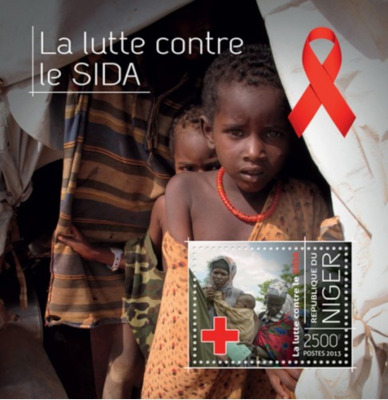
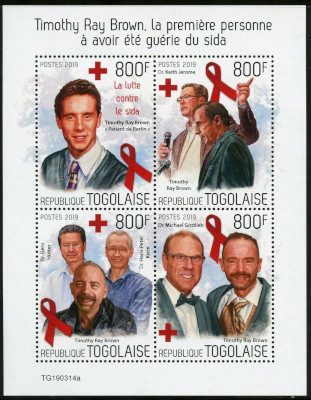
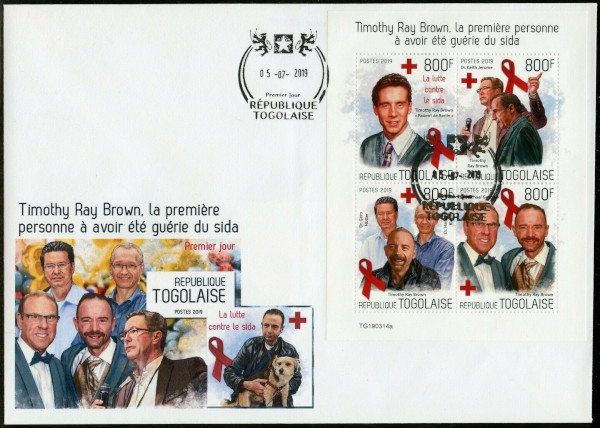
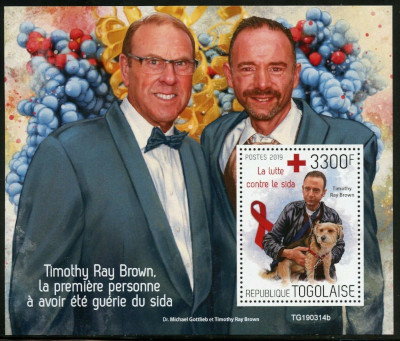
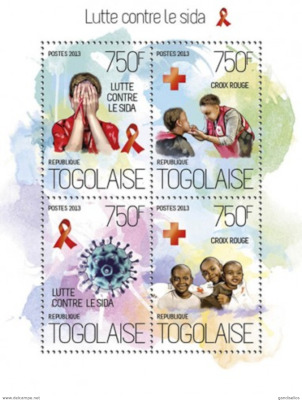
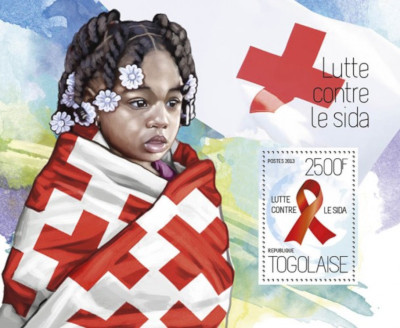
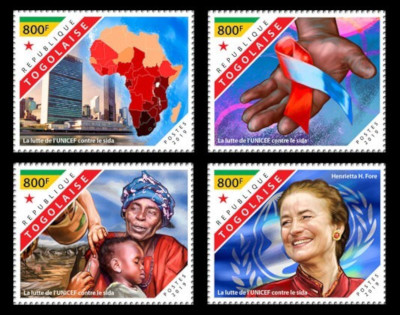
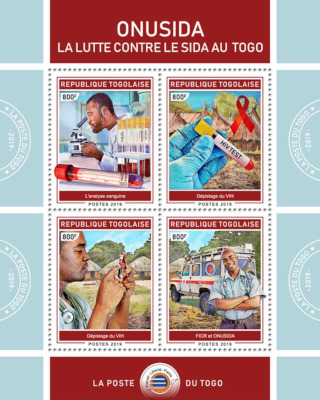
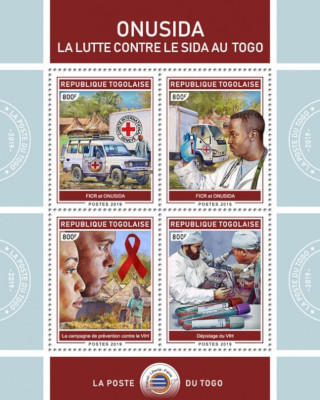
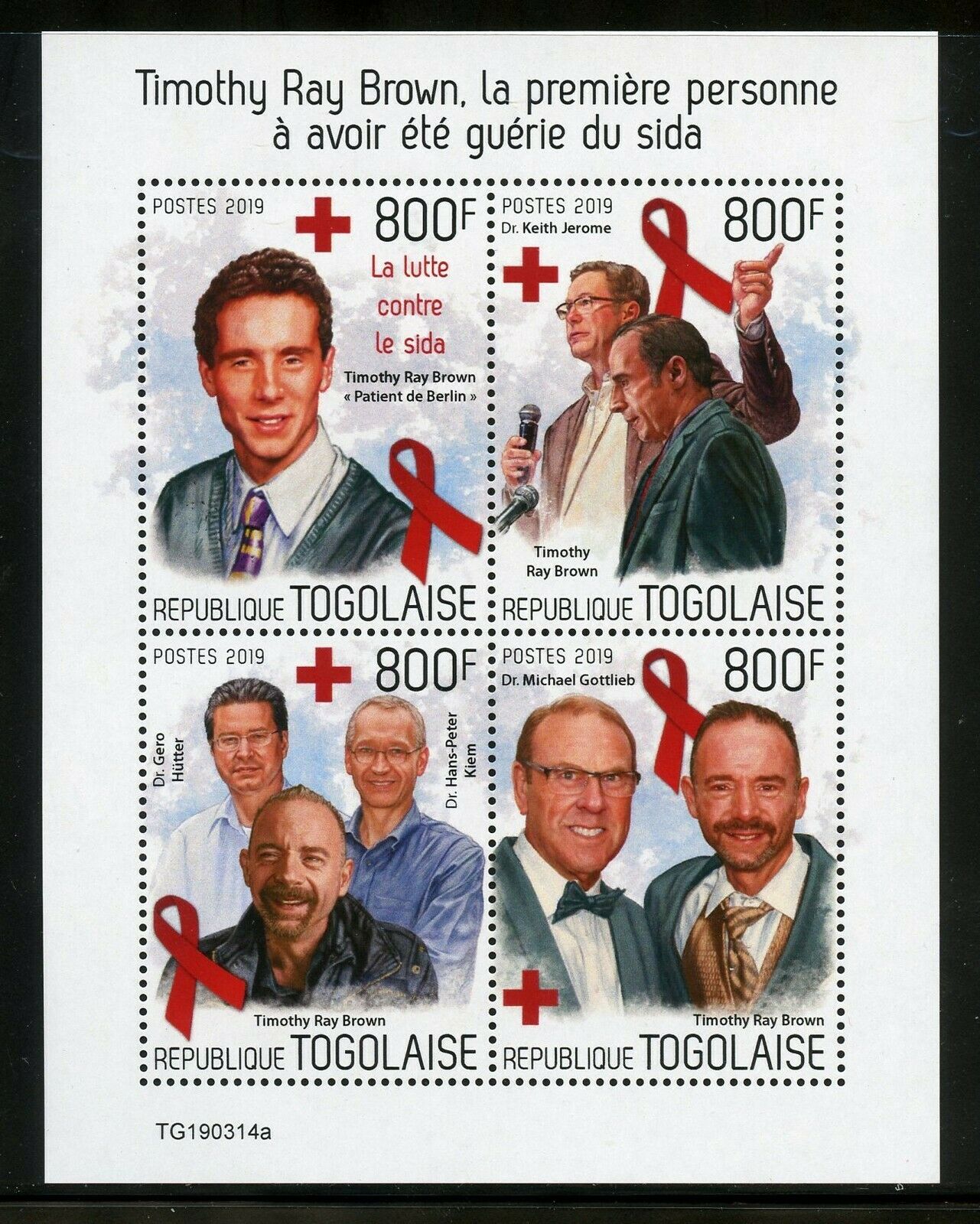
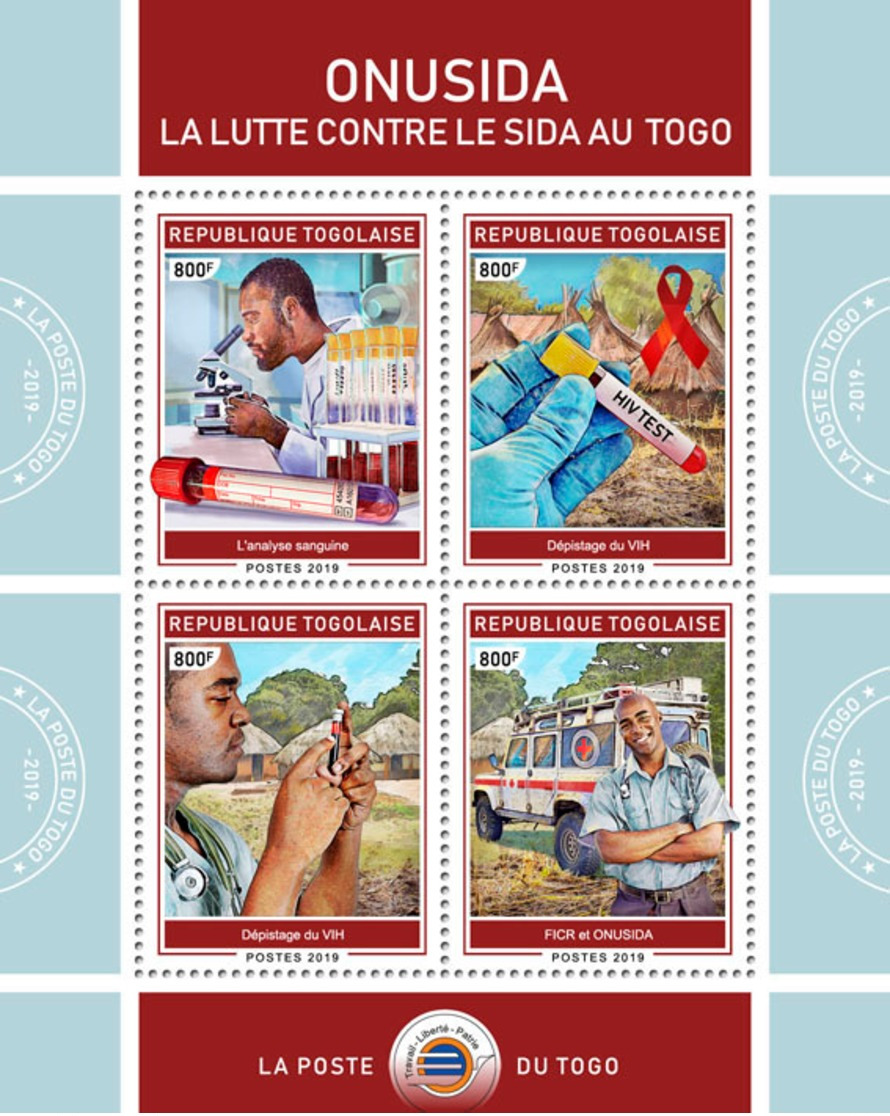
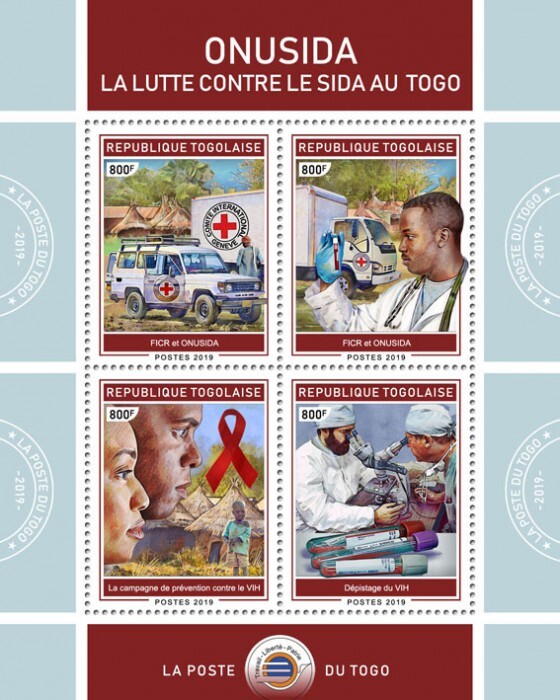
Togo has released four new stamps and a souvenir sheet... maybe. As we discussed a few months ago, a company seems to be spreading stamps of their country via questionable dealers. This is certainly excess stampage at best, illegal issues at worst. So these stamps may be authentic or may be junk. We'll keep an eye on them over time.
Then there are these two souvenir sheets from Mozambique. The same questionable seller has them on Delcampe making the validity and value of these stamps suspect. I so wish there was a way to inquire with the postal service of Mozambique whether these are valid or not, but I never receive a response to my inquiries (assuming I can even find a valid address for their postal service). If you'd like to see an example of a valid AIDS release from Mozambique, you can check out this 2006 release. It's nothing like the below overproduced Elizabeth Taylor release, which convinces me further these are junk stamp releases.
More news to report, but I want to get this posted today. Keep an eye on the site over the next few days. - June 20, 2011
- My little surprise for all of you is now ready. A collection of 24 AIDS on Stamps Project newsletters published by Canadian AIDS topical philatelist Blair Henshawduring the 1990's. They're filled with lots of interesting articles about AIDS stamps that I have never published on this website, along with pictures of "new" cinderella stamps, local post stamps, cancellations, rare first day covers, and lots more.
I'll be eventually making some changes on the site to promote some of the new information contained within these newsletters, but for the next month I'll be busy remodeling part of my house and taking a long overdue vacation with my family. I'll try and update the website periodically, but expect the updates to be brief. In the meantime, enjoy the newsletters! - June 16, 2011
- June certainly is going by fast. I've been working something related to this website here. I'm not ready to announce them, but I will tell you to watch for something very neat to be added to the website in a week or so. So if you're wondering where my almost-daily updates went, that's where. Watch for it.
First up, Xtophe continues his excellent research. He has learned that Armenia plans to release an AIDS stamp. An individual stamp as well as a souvenier sheet with two stamps. The print run for this is 30,000 and the stamp will be released in the third quarter of this year.
Second, a dealer on Peru has started selling this stamp. There is nothing about it on the Peruvian postal service website, although the website has not been updated for any 2011 stamps yet. Oddly, the stamp specifies it is about World AIDS Day. Considering we're almost exactly six months away from World AIDS Day, it's either unusually late for 2010 or early for 2011. The seller specifies it is for 2011, which would suggest its an early release. Perhaps we'll see more of this in the near future.
Third, I found an old AIDS stamp checklist from the mid-1990's that included this 1991 Ethiopia stamp release. Look at the bottom-center stamp. Are those small red ribbons on the board? These are the only two scans I have been able to find of the stamp. The issue is Scott 1310-5, and the specific stamp is Scott 1314. Can anyone send me a higher resolution scan so we can determine this either way? Later versions of the list did not include this stamp, so it's entirely possible that it is not AIDS-related. But we should research this issue either way.
Finally, Ricard has completed an investigation that AIDS on Stamps has been trying to solve for a year now. After communicating with the Israeli Philatelic Foundation, he was able to identify the stamp on the first day cover below as being a personalized stamp tab.
Time to get back to work on the update for next week. - June 11, 2011
- Today has been unexpectedly quiet as far as official stamp releases goes, but I do have some interesting releases from the Terra Candella local post.
In case you don't remember, local posts are historically private postal services that operate in areas where a country's postal services does not provide reliable service. For example, a remote settlement might have an enterprising person who charges a small fee to take a letters to a town where they can be easily mailed. Local post stamps are traditionally placed on the lower-left corner of the frnt of an envelope with their own cancelation mark on them.
In recent years, artistically-inclined philatelists have created their own local posts. Not necessarily as a for-profit business, but as a fun philatelical hobby or an artistic statement. Sometimes they create elaborate backstories for the regions they hypothetically serve.
Terra Candella is a local post run by artist Harley (no last name). Harley is an professional artist who present collages, drawings, paintings, etc. on postage stamps. He uses stamps as a means of presentation, both in sheet form, as an individual stamp, or with a cancelations mark on an envelope. I have written about Harley before, but today he e-mailed me new scans of his works.
There are too many scans to show them all on this page, so I refer you to our local post page. But for now here are two examples of his work.
- June 10, 2011
- This week just isn't stopping.
First, Cambodian Philately, a stamp blog, has been tracking the development of a set of AIDS stamp to be released this month. Four values plus a souvenir sheet. More details as they become available.
Second, Ricard sent some interesting links about the work the International Labor Organization (ILO) is doing in regards to the ongoing UPU AIDS education project. Of particular interest is the list of stamps releases they are tracking. We have a few listed that they do not, and they have some new information for us. There are some errors in their information though, such as last year's Dominican Republic release being two stamps, not one as they claim. They have also listed the release date for every stamp in their list as June 3, which is incorrect in most cases.
According to the ILO, the rumored Slovakia release is the same as the one they did last December for World AIDS Day. Hardly surprising, as most countries wouldn't bother releasing stamps on the same topic six months ago. It's possible there will be another Slovakia stamp, but I think they're right and we can safely remove this from our list of expected releases for 2011. Moldova is listed in a similar fashion, so I doubt they'll be releasing anything else this year.
The ILO also says that New Caledonia is not releasing stamps, but is releasing pre-stamped postal envelopes with an AIDS logo on them. ILO only has one listed, but friend-of-the-site Xtophe received an e-mail from the New Caledonia postal service saying that they will release this envelope in two values: 110 and 140 francs. The ILO had one pictured, although which value is this envelope I can't tell.
The ILO also had these images for the Fiji stamps. I have no further information about their release date, and have not seen them for sale yet.
Third, on the subject of pre-stamped envelopes, the Russian postal service also e-mailed Xtophe to say they were not releasing a stamp but would release an envelope. No picture or details yet.
Fourth, Xtophe received an e-mail from the philately department of the Turkish postal service. They said they have no issues this year along the theme of AIDS. The UPU got this one wrong when they added it to their list of forthcoming stamps. If they will be using a special cancellation mark they made no mention of it in their e-mail.
For what it's worth, Xtophe has also been sending blind e-mails to postal services not on our list inquiring about AIDS in their 2011 release schedules. France says they have nothing relevant on their schedule. The same goes for French and Spanish Andorra, Monaco, Aruba, and St. Pierre and Miquelon (I've never even heard of that last one).
I'm sure I'll have more updates over the weekend. Check back soon. - June 9, 2011
- Another day, another stamp. Today comes Bosnia-Herzegovina (Muslim / Sarajevo administration). I don't have any details on the stamp yet, but I do have this image.
I'll probably have more to report later today. Check back. - June 8, 2011
- The busiest week in the history of AIDS stamps continues.
Today there are two new issues to report, both of which I am pleased to report are quite beautiful stamps.
First up is from Romania. Note that the only the bottom stamps on the sheet will have the UNAIDS tag attached. And there are two side labels on the sheet as well. Accordingly, collectors will want to make sure of what they're ordering before they buy this stamp, else they might miss out on the tabs.
I have a link to technical details on this stamp. The stamps are either on a sheet of 32 stamps, or on the 12+4 tabs (as seen above). So if you buy a sheet, make sure it's the one that you want. The number of stamps being released is 32,000 in sheets of 32, and 16,608 on the 12+4 tabs. Another 325 first day covers are being produced.
The other stamp today is from Pakistan. I have no details on it other than these images:
There'll be more next in the next day or two or three, so keep checking back. - June 7, 2011
- My work on AIDS stamps continues and I have a few more things to report.
First, in going through all my back mail (it does pile up at times), I found a note from friend-of-the-site Ricard. He pointed out that Bosnia and Herzegovina (Sarajevo / Muslim administration) is releasing a stamp on June 6 which was yesterday. Hopefully we'll see an image soon.
Second, I received an e-mail from another friend-of-the-site, Xtophe, who has created a blog about French AIDS philately. It's in French, so non-French speakers will want to use Google translate.
Third, I have learned something new about the mysterious China (2006) booklet seen here.
Front and back covers:
Left and right pages:
Close-up of the sheet of stamps and the AIDS stamp:
Thanks to the folks at Usenet (thanks Richard and Tony!), I have learned that this is a sheetlet of personalized stamps. Well, not the stamp per se, which is Scott 3261, but the tabs attached to it. They were created by the (loosely translated) Guizhou Provincial Disease Prevention and Control Center.
Now that we know they are personalized stamps, I have moved them to the personalized stamp page and removed them from the 2006 stamp issues page.
More updates in the next couple of days. - June 6, 2011
- Some days you've got the world in your hand. Other days the world rolls right over you. This is one of those days.
I just finished adding an update to the website this morning proclaming the new Togo issue to be an illegal issue. I didn't have full proof, but the evidence was good enough for me. Xtophe, a regular reader of the website, decided to ask the source directly. He e-mailed the Togo postal service asking them if they had it available for sale. They wrote back saying that they indeed had the block for sale.
So I for the second time in as many days, I have reversed my prior opinion and am officially declaring this stamp to be valid. My only explanation as to why suspect distributors are handling this stamp first is that Togo has hired another company to assist them with excess stampage. Which, while sad, wouldn't surprise me. The immediate revenue for a country's postal service is too tempting to pass up, even if it means devaluaing the collectability and reputation of their stamps overall. In the meantime, I offer my apologies to the Togo postal service and anyone distributing this stamp. I'm still a bit wary, but was apparently wrong on this one.
I am therefore putting the stamp back in its place of honor on this website. Expect the necessary changes on the site to be complete in the next hour or so. - June 6, 2011
- A few bits of news today, none as exciting as yesterday's update.
First, I'm making progress identifying the Israel 2003 stamp issue on the under investigation page. I now have a scan of a first day cover.
What interests me is the lack of any apparent writing on the stamp. That suggests it is just a cinderella issue. This is greatly corroborated by the fact that Israel has many dedicated stamp dealers, none of whom were able to identify the stamp when I initially contacted them last year. Now that I have a picture of the FDC I am hoping that a few doors will open to me. The investigation continues, but in the meantime be aware that I am making progress.
Second, a list of forthcoming AIDS issues this year. I'm sure there will be more, but these are the ones I know of...- Algeria will release an AIDS stamp (stamps?) on June 30.
- Mauritius, an island nation east of Madagascar will release a single stamp.
- Uruguay will release an AIDS stamp on December 1.
- Brazil will release a set of four AIDS stamps in June.
- Ukraine will release a single AIDS stamp on December 1. The stamp will based on the winner of a national competition
- Dominica (not to be confused with the Dominican Republic) will release one stamp.
Third, I have decided that the issue from Togo I mentioned yesterday is an illegal issue. I spent several hours researching the issue today. My evidence is as follows:
1. According to the Togo's postal site, their authorized philatelic representative in the United States is the Inter-Governmental Philatelic Corporation (IGPC). Basically, they're the folks that print their stamps and sell 'em to dealers, as Togo's postal service is too small (and they don't speak English). Yet the IGPC's listing of Togo stamps doesn't mention it.
2. None of the stamps IGPC made for Togo look anything like the Diana issue. Nor have they ever created anything even vaguely similar on any of IGPC's 431 Diana issues that they have made for countries around the world.
3. I have only been able to locate two dealers so far that are selling the new Togo issue. Harley_NJ (from Taiwan) on Delcampe, and Stamperija in Belgium. Both of whom I gladly call out as dealing in poor quality stamps from African countries dealing in excess stampage. Because these nations are either releasing stamps like mad (via companies like IGPC) or have unstable or poor governments unable to clarify what stamps are leigimate, it is dificult at best (impossible at worst) to determine whether stamps from these countries are legal or not. And gee, dealers like Harley_NJ rarely seem to keep stock around long, focusing only on recent issues that Scott has been unable to catalog. As soon as Scott catalogs a country's stamps for that year, those stamps suddenly vanish from their inventories.
Please note that I am not calling either of these dealers fraudsters. As Penn & Teller would point out, doing so opens one up for legal action. I would, however, call them assholes (which is legal) who make money selling highly suspect merchandise that few reputable dealers are willing to handle. The nature of their merchandise is often impossible to verify as authentic. They rake in massive amounts of money from collectors who mistakenly believe their products have value. (Indeed, some of their merchandise does have value, making it even more difficult to sort out the illegal issues.)
In my opinion, no one should ever buy from a dealer like this. They are the philatelic equivalent of a guy who walks up to you on the street and says, "Pssst, would you like to buy a watch?". They are not to be trusted. If the stamps they deal in are legitimate and authorized, they will be around for years to come and you will have no trouble acquiring them once Scott catalogs them. And by waiting, you can be sure that you aren't giving your money to a dealer (printer, graphic designer, etc.) selling illegal stamps.
4. The Togo issues are filled with classic imagery for makers of illegal issues -- Princess Diana, Pope John Paul II, Nelson Mandela, and the International Red Cross, all of which are in high demand by collectors. If you'd like to see more examples of this on illegal and questionable stamps, check out our illegal issue and under investigation pages. Since the illegal issue stamps began flooding the market a few years back I have yet to be able to verify even one of these as being authentic.
Ultimately, countries must be responsible for making clear what releases are officially authorized by their postal service. For most countries that isn't a problem because they post the list on their websites or in other postal publications. Or even just submit a list to the Universal Postal Union. But for countries that engage in excessive stampage, they may not even know what stamps they have licensed to bear the name of their country. Or even if they know, they may not care. So when a stamp like the Togo (2011) issue comes along, and when the evidence suggests that its authenticity is questionable at best, it's a fair assumption that the stamp is an illegal issue.
Should it turn out to be legit, its widespread availability now means it won't be hard to pick up a copy in five years. I suspect its value in five years will be the same as its value now though -- zero. As such, I have put this on my illegal stamps list until evidence emerges that this is a valid release. Should I be wrong, I'll gladly move it back to my valid lists with an apology to all concerned.
Fourth and changing subjects, the Universal Postal Union posted a Youtube video of AIDS stamps. All are fairly recent issues (since 2002) they have cataloged in their numbering system, but it's still a cute little video.
Fifth, it turns out that Bosnia and Herzegovina "cheated" a little a on the UPU's recommendation that member countries release AIDS stamps this year. Rather than a stamp, they elected to release a special cancelation mark. Details are available (in Croation) on their website.
I did manage to snag an image of the cancellation though. (Ricard sent me a copy as well -- as always, thank you!)
I think there's more news, but my son is now on my lap watching Dr. Seuss videos on Youtube. As such, it is now difficult to get any work done. More soon! - June 4, 2011
- The Facebook page has been slowly gaining followers. We're up to six right now with more people slowly joining. Considering AIDS philately is a specialized topic, I am pleased with how the page is growing. If you're on Facebook and you "like" our AIDS on Stamps page then you'll be informed as to new AIDS stamp releases before this website gets the updates. (Such is the advantage of posting on a much simpler medium.)
Of course the updates do get posted here eventually, on days like today when my son is napping and nothing is happening that requires my immediate attention. And so without further ado, the news...
North Korea (aka the Democratic People's Republic of Korea) has released a souvenir sheet to commemorate the International Year of Volunteers. The center-left stamp has an AIDS ribbon on it as seen here:
According to the information supplied by Ricard (who has been sending tons of information on new issues -- thank you!), this sheetlet was released on March 31, 2011 with 20,000 sheets printed.
Another recent release is this issue from Kazakhstan. This stamp was released as part of the Universal Postal Union commemoration of 30 years since the discovery of the HIV virus. It was released on June 3, 2011 with a circulation of 30,000 "pieces". The translation of pieces is a bit off -- sheets? stamps? I'm not sure.
Another new release comes from Togo. This one is a lot more suspicious though. Notice the design...
On this stamp is Princess Diana, Pope John Paul II, and Nelson Mandela, all of which are public figures whose images have been heavily used on illegal stamps because of their high collective value. Even the design of the sheet (four equal sized squares with a border) is commonly used on illegal issues.
It is worth mentioning that none of this makes the Togo set illegal. It could very well be a case of excess stampage. If you're a poor country who can barely make their own postal service work, it's an easy source of income to let an outside graphic designer, printer, and distributor working in tandem create and sell stamps abroad from your country. Your country would then receive periodic checks. No single stamp would be worth much, but when this is done across hundreds or thousands of stamps the level of income starts going up significantly. It's an easy source of income for a poor country, but devalues the collective value of their stamps overall. Especially when these companies decide to cut out the royalties and keep all the profit for themselves (in which case the stamps become illegal issues).
Togo has certainly engaged in excess stampage. Since 1995 their stamps have included Chinese presidents, numerous(!!) blocks about Princess Diana, Elvis Presly, Catholic Popes, Rembrandt, Mozart, and many historical events of the US space program. And these are the stamps they list on their own postal website. If you were to consider possibly-illegal issues mentioned on other websites you'd find issues like the millionth Volkswagon, the death of Eva Peron, and a celebration of the first McDonalds francaise.
To assist in their releases for the foreign collectible market, Togo hires the Inter-Governmental Philatelic Corporation. These stamps are generally not sold in their clients' home countries, and may not even be postally valid except under special circumstances by their postal service's philately office. Annoyingly, the IGPC doesn't provide a list of authorized stamps on their website, making it diffiicult to ascertain what is legitimate and what is not.
Bottom line: is the Diana issue valid? I don't know. Togo releases so many stamps unrelated to their country that it's virtually impossible to tell what is legitimate and what is not. Their postal website does not list stamps beyond 2006 or so making verification even more difficult. So when Togo issues stamps that are widely understood to be legitimate like these...
... they are drowned out by generic stamps like the Diana issues above. The set of three 2007 AIDS stamps is Scott 2064-6, by the way. I have no idea if Scott will list the new sheet.
So in the meantime, I'll treat the new stamps as legitimate. I will continue to research the issue anyway. If I learn something notable I'll be sure and let you know.
Next up is an issue from Serbia.
I have no other information about this issue other than it is obviously part of the UPU's AIDS awareness campaign. (Note the suckers on the virus. An AIDS virus with suckers is more accurate than the spiked versions seen on stamps from Morocco and Yugoslavia.)
Now onto Belarus. This stamp was released on May 12.
This is is a good stopping point for now. More news in the next day or so. - April 19, 2011
- Just a small blip of news. The country of Belarus will be releasing one AIDS stamp in June as part of the UPU AIDS education project. No picture yet.
- Also, to better make the latest AIDS stamp news available to you, I have created an AIDS on Stamps Facebook page. This will allow regular Facebook users to stay up to date on the latest AIDS stamp news before updates are posted on this website.
Facebook is lighter and faster than maintaining this website, so it's easy for me to keep it current. In addition, users will be able to submit their own news to the page as well, so it's a great way to alert me and the entire AIDS stamp community at the same time. You even have the ability to upload pictures of forthcoming stamps as well.
Never fear, this website will continue to be updated regularly. I tend to work on this site in bursts though, so the Facebook page is a more effective means of getting the very latest AIDS stamp news.
Here's a little plug-in to give you an idea of the sorts of updates you'll find there.
- April 16, 2011
- Two months have gone by and I've got a bit of news to report.
First, Gwen from Vancouver and I have been investiating this Madagascar souvenir sheet from 1996. The sheet honors the 100th anniversary of the death of Louis Pasteur. The animals in the upper-right signify the vaccine against rabies that he developed. But what is the virus in the lower-right? Pasteur developed several vaccines in his life, but the virus with the points doesn't look like any of them. We theorize that it might be a stylized AIDS virus. He died long before the AIDS epidemic, but the institute named after him in France was where the AIDS virus was first identified (yes, there is some debate on this subject).
In fact, the AIDS virus doesn't have points. It has what looks more like suckers. That hasn't stopped artists from drawing it that way, as seen in this Moroccan stamp.
At this point I am undecided on whether this constitutes an AIDS stamp. It could be, or it might not. As such, I have placed it on the Under Investigation page. Once I get a better scan of this stamp and can read the writing on the bottom more clearly (of which the graphic designer's name may be printed), I will try and track him down to ask what his intention as an artist was.
Second, I found this Libya (1986) stamp being advertised as about the AIDS virus. While the skull in the drop of blood is certainly suggestive of AIDS, I still doubt this is an AIDS release because this would make it the earliest stamp about AIDS by two years, and because there is no evidence to suggest that its intent was to recognize AIDS as a problem, I have placed it on the Not About AIDS page. If anyone has any evidence to the contrary, let me know and I'll be glad to recategorize it.
Third, a sneak peak at the forthcoming United Nations stamp releases about AIDS. There will be a new "event sheet" to glong along with it, whatever that means. Thanks to Gwen and Xtophe for their information about this release. Watch for the actual release in June.
Fourth, a new 2010 stamp from Argentina. In automated kiosks around the country, stamps can be printed with varying values. From September 3 to December 4, 2010, these stamps contained a message about AIDS awareness. Translated, they read, "Stopping discrimination is key to AIDS prevention." It is worth noting that these labels were offered before and after these dates with messages not related to AIDS, so if you purchase this stamp make sure it has a message relevant to your collection. Also, the value on these stamps can vary. I am uncertain if customers chose from a set of pre-determined values, or whether the value is fully customizable.
- February 7, 2011
- A few things to report today.
First, I played around with Google doing searches for AIDS stamp releases in French, Spanish, and German. This isn't an easy process as I don't speak these languages, but with the assistance of Google Translator I was able to determine whether I was looking at something useful or not. And indeed, in three cases I was looking as interesting information - upcoming AIDS stamp releases for 2011 for the United Nations, Algeria, and Mauritius (a series of islands to the east of Madagascar).
I have no further information on Mauritius stamp (or stamps). I learned the United Nations release is scheduled for June 3 and will be released from all three of their world headquarters. I have no idea how many stamps they are releasing. Algeria is releasing one value of a stamp on June 30. These are just the tip of the iceberg, of course. There will likely be dozens more countries releasing AIDS stamps this year. It's gonna be BIG.
Second, Gwen wrote me yesterday to tell me about this Dominican Republican release on December 1, 2010. They're quite colorful stamps and will be an excellent addition for every AIDS stamp collector.
Third, I removed the "for sale/trade" page from the website. I get a lot of letters from people asking me to sell them stamps, and I really have no idea what the value of any given stamp is. The page has become distracting from my focus on this website, so by removing it I will be able to prioritize new and interesting updates about AIDS stamps.
Fourth, I recently (well, a few months ago) spent an afternoon in the Collector's Club Library in New York City. My goal was to research a number of nuanced issues about AIDS stamps, such as South African stamp booklets featuring AIDS information, and releases from within the area formerly known as Yugoslavia.
Sadly, they had absolutely nothing on any of these subjects. If I had been looking for an obscure stamp from British Colonies a hundred years ago, they would have had a host of resources. But AIDS stamps are too "modern" to be found in their information. They have virtually no up-to-date foreign stamp catalogs. Even their most recent Michel and Yvert stamp catalogs were well over ten years old. I understand they are on a budget, but I was still highly disappointed. I would think acquiring foreign catalogs would be a fairly high priority for their library, particularly for topical collectors. (The Collector's Club still a great resource for philatelists though).
And so my research was limited to clarifying a few minor issues in the latest Scott Catalogs, as well as looking at the 2010 Stanley-Gibbons catalog. The latter was able to fill in numerous blanks for Stanley-Gibbons on our Excel spreadsheet of AIDS stamps (.xls format).
New listings have also been added to the spreadsheet for stamps added to this website in the past week. I have also added a few other catalog numbers that have trickled in from readers over the past few months.
Fifth, thanks to Satish for sending in an image of this PWA stamp of John Curry, former Olympic ice skater. I don't collect this particular aspect of AIDS stamp, and so I depend on people like him to submit scans.
Finally, I want to give a big thank-you to everyone who has been writing me with information for this website. That includes Gwen from Canada, Ricard from Spain, Ha from Viet Nam, and Xtophe (from somewhere). Your assistance helps make this website possible and I appreciate the information that you provide me.
This pretty much winds down this week's burst of updates. I'll post again when I have more to report. - February 3, 2011
- I recently purchased this interesting "booklet" from China. It's a large (8.5 inch tall x 11.5 inch wide) envelope with a cardboard "booklet" inside. The cover of the envelope is the same design as the cover of the booklet. The booklet looks like this...
Front and back covers:
Left and right pages:
Close-up of the sheet of stamps and the AIDS stamp.
I'm not entirely sure what to make of this set. The stamps themselves aren't AIDS stamps, but they have attached labels representing various health themes or organizations. For example, there is a "no smoking symbol", the AIDS ribbon, a Stop TB logo, and several I do not recognize. The stamps themselves are behind a small piece of plastic covering inside the booklet. They can be removed revealing a printed image of them on the cardboard. The stamps are valued at 80, although I do not know the denomination. The stamps do not have a year listed on them (at least in English), but the booklet says 2006 on the cover. There is also an envelope inside (no picture shown) with a delivery address printed in Chinese, but I am unsure of the envelope's purpose. To solicit donations, maybe?
I'll add this to the list of stamps under 2006, but I really don't understand this release. If anyone can read the text I would appreciate an explanation or translation.
That's the last of my slew of updates, but there are a few "housekeeping" things I'll discuss in my next update. - February 2, 2011 (update #2)
- Yesterday's flood of news continues while a snowstorm grips North America. I hope everyone is having a fun time shoveling snow out of their driveway.
First, this sheet of Netherlands showing stylized African women and red AIDS ribbons was released in 2010.
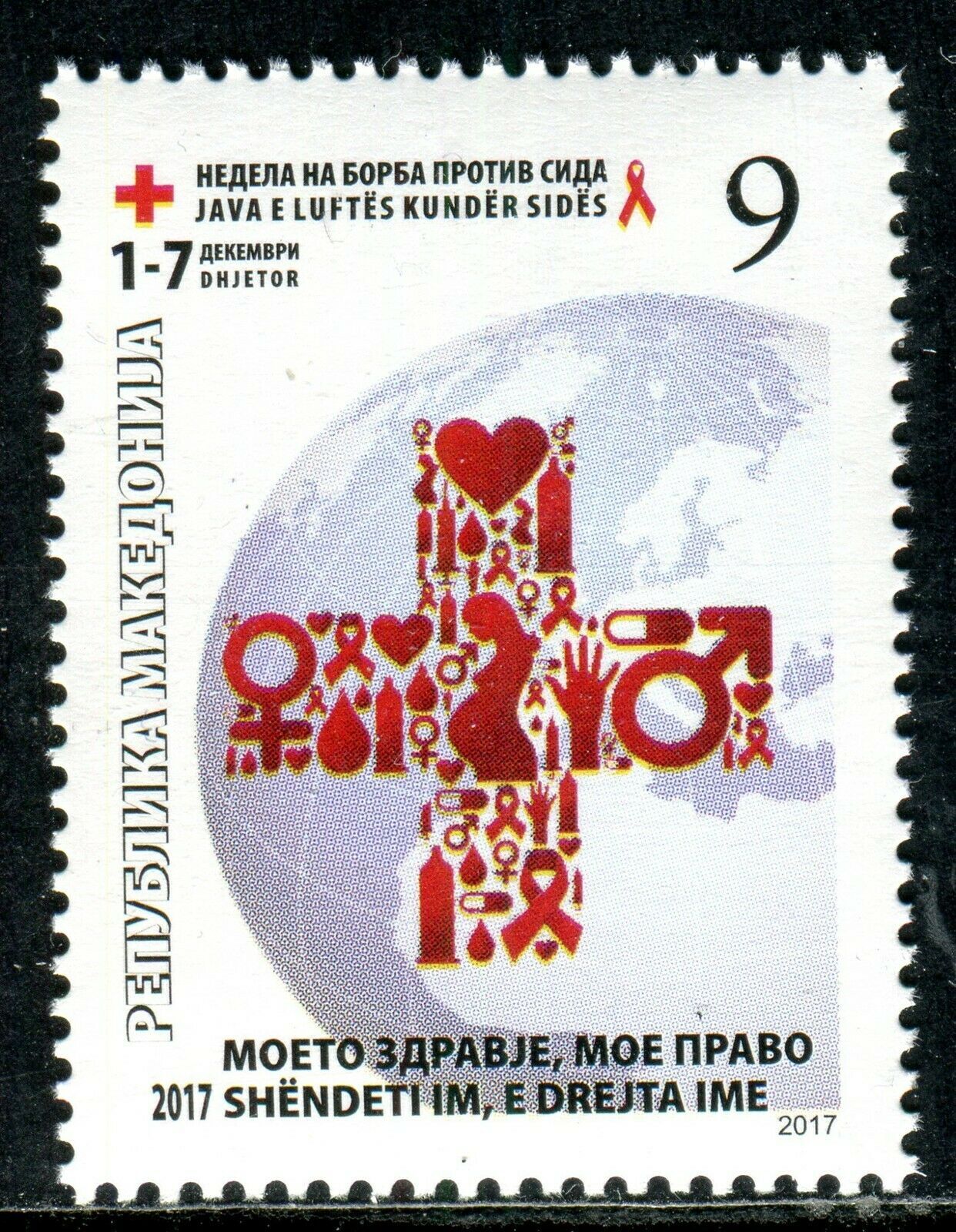
Second, Macedonia releases a semi-postal tax stamp every December on the subject of AIDS, and 2010 was no exception.
Third, last September I wrote about a series of Cinderella stamps I found from Bosnia and Herzegovina (Serb Administration). I now know considerably more about them. There were 15 of them released in all and were part of a worldwide Red Cross AIDS educational effort called "The truth about AIDS. Pass it on...". As a small part of that program, Red Cross chapters were encouraged to reprint 15 images in their local language and use them for promotional purposes. They could be used as posters, postcards, stickers, stamps, or whatever.
The Red Cross has conveniently made a gallery of the various designs available.
Either way, there are various cinderellas floating around from the stamps made as part of this program. Here is a picture of the full set from Bosnia-Herzegovina (Serb Administration). The image last September was only part of the full set, but here they all are.
My 18 month-old son is now awake from his nap -- all work has come to a screeching halt. More soon. - February 2, 2011
- It's been months since my last update. In part beacuse things have been quiet on the AIDS philately front, and in part because raising my son is keeping me very, very busy. Fortunately there are a few interesting things to report.
First up, in my last update I mentioned that I sent letters to three foreign embassies to ask if any of their AIDS stamps were valid releases by their agencies, or if they were unathorized by their government. Two of the letters came back return to sender, and the third never received a reply. So much for this strategy.
Second, 2011 has now arrived. The Universal Postal Union's international campaign against AIDS is ending this year. As their 2011 section of that campaign, they are asking all member nations to release stamps about the discovery of the AIDS virus in 1985. So expect a slew of countries to release stamps this year, particularly in December for World AIDS Day.
Third, this rather bright AIDS stamp was released by Slovakia in late 2010.
Fourth, look at this pair of images. The left image is the well-known 2001 Bangladesh AIDS stamp. The image on the right is a mock-up the graphic designer used while creating variations on the stamp. I found it on sale on Delcampe for $50 or so. That was more than I was willing to pay for it (especially if it's not acid-free tape thereby requiring the services of a professional restorer), but I don't think it ever sold. The image on the right was never released as a stamp, but it is an interesting design.
Fifth, this stamp is being advertised online as an AIDS stamp, but is in fact a stamp about bone marrow donation. Accordingly, I have added it to the Not about AIDS page.
There's more to report, but it's late I'm off to bed. Look for an update in the next couple of days.
Updates prior to this point can be found in the archived news page.
This website went online September 15, 2007.